Turin Travel Guide: Egyptian Museum, Chocolate and Italy's Underrated City
Look at an Italian 2-cent coin and you will see a building that was supposed to be a synagogue. Turin's Jewish community commissioned the Mole Antonelliana in 1863, then watched architect Alessandro Antonelli keep adding height and costs until they gave up and swapped it with the city for another plot. Antonelli kept going. When the spire was finished in 1889 it rose 167 metres, at the time the tallest brick building in the world, and today it holds a cinema museum with a glass lift running straight up through the middle.
That is Turin in one story: ambitious, a little eccentric, and far less crowded than Milan, Florence or Venice. It was the first capital of unified Italy, it keeps the Shroud, it invented the gianduiotto and popularised vermouth, and it has the most important Egyptian collection outside Cairo. Most visitors still skip it. Here is how to do it right in two or three days.
Getting to Turin from Milan
High speed trains (Trenitalia Frecciarossa and Italo) link Milano Centrale or Porta Garibaldi with Torino Porta Susa and Porta Nuova in about 50 to 70 minutes. Booked in advance, fares often start around €10 to €15; on the day they can double. Slower regional trains take close to two hours but cost a fixed, lower fare. That makes Turin an easy day trip from Milan, although it deserves at least one night.
Porta Nuova is the more central station: from there you walk up Via Roma to Piazza San Carlo and Piazza Castello in 15 minutes. The historic centre is flat, compact and lined with 18 km of arcades, so you can explore it on foot even when it rains.
The Egyptian Museum (Museo Egizio)
Founded in 1824, the Museo Egizio is the oldest museum in the world dedicated entirely to ancient Egypt, and Champollion himself studied its papyri while he was cracking hieroglyphs. Highlights include the Statuary Gallery with its row of pharaohs (Ramesses II is the star), the intact tomb of Kha and Merit with its bread, wigs and linen still in place, and the Turin King List papyrus.
- Price: around €18 for a full ticket in 2026, with reduced rates for young visitors. Free with the Torino+Piemonte Card and the Abbonamento Musei.
- Booking: tickets are sold online only, with a timed entry slot. Book a few days ahead for weekends.
- Hours: usually 9:00 to 18:30, with a shorter Monday (until 14:00) and late Saturdays. Some rooms close for works from time to time, so check the website before you go.
- Time needed: three hours minimum. Go first thing in the morning.
Mole Antonelliana and the National Cinema Museum
Inside the Mole, the Museo Nazionale del Cinema fills the huge central hall with deck chairs where you can lie back and watch films projected on the walls, surrounded by spiral ramps of props, posters and early optical devices. It is one of the most fun museums in Italy, even if you are not a film buff.
The panoramic lift is a glass cabin that climbs 85 metres in about a minute, hanging in the void of the dome, to a terrace with a 360 degree view of the city and, on clear days, the snowy Alps behind it.
- Price: the official list shows around €16 for the museum, €9 for the lift and €20 for the combined ticket. Verify current prices on the official site.
- Closed on Tuesdays. Lift slots sell out, so book online, especially for sunset.
- Hazy summer afternoons kill the mountain view; clear winter mornings are best.
The Shroud: what you can (and cannot) see
The Shroud of Turin is kept in the Cathedral of San Giovanni Battista, in a climate controlled case in a side chapel. It is not on public display. The Church only shows it during special ostensions: the last big public one was in 2015, and the 2025 showing was reserved for young people from the diocese. As of October 2026 no public ostension has been announced, so check sindone.org if you are planning around it.
What you can see is a full size photographic reproduction in the cathedral, the Museo della Sindone on Via San Domenico, and Guarini's spectacular Chapel of the Holy Shroud. Its black marble dome almost burned down in 1997 and reopened in 2018 after a 21 year restoration. You enter it through the Royal Palace.
Royal Palace and the Musei Reali
The Palazzo Reale was the seat of the House of Savoy, the dynasty that ended up ruling all of Italy. One ticket (around €15, verify before going) covers the palace apartments, the Royal Armoury, the Galleria Sabauda, the Archaeology Museum and the Guarini chapel. Allow two to three hours. The Musei Reali are closed on Mondays, and like other state museums they are free on the first Sunday of each month (expect queues).
Is the Torino+Piemonte Card worth it?
The card is valid for 1, 2, 3 or 5 days. The 1 day version starts at about €30 and the 3 day version is around €55. It gives free entry to the Egyptian Museum, the Musei Reali, the Cinema Museum and dozens of other sites, plus discounts on the Mole lift and public transport. If you visit the three big museums in two days, it pays for itself. If you only plan on the Museo Egizio, buy single tickets.
Bicerin, gianduiotti and the aperitivo
Turin eats and drinks better than its reputation suggests.
- Bicerin: espresso, hot chocolate and cold cream layered in a small glass, never stirred. The original is served at Caffè Al Bicerin (Piazza della Consolata), open since 1763, a tiny room with eight marble tables where Cavour is said to have waited for the royal family to leave mass. Expect to pay around €7 and to queue. Check the closing day before you go, as it shuts one weekday.
- Gianduiotto: when Napoleon's blockade made cocoa scarce, Turin's chocolatiers stretched it with Piedmont hazelnuts. The result, gianduja, became the boat shaped gianduiotto in 1865, the first individually wrapped chocolate. Buy them at Caffarel, Guido Gobino or Pfatisch.
- Historic cafés: Caffè San Carlo, Baratti & Milano and Mulassano (where the tramezzino sandwich was born) are worth one coffee each for the interiors alone. Table service costs more.
- Aperitivo: Turin says vermouth was born here in 1786, and the aperitivo is a serious evening ritual. From about 18:00, a drink (typically €10 to €15) comes with a generous spread of snacks. Try San Salvario, the Quadrilatero Romano or the arcades of Piazza Vittorio Veneto.
Do not leave without tasting agnolotti del plin, vitello tonnato and a glass of Barolo or Barbera.
A two day plan
Day 1: Museo Egizio at opening, lunch in the Quadrilatero Romano, bicerin at the Consolata, then the Musei Reali and the cathedral. Aperitivo in Piazza Vittorio.
Day 2: Cinema Museum and the Mole lift in the morning, walk along the Po through the Valentino Park, then cross the river and climb to Monte dei Cappuccini for the classic view of the Mole against the Alps. If you have extra time, take the rack railway to the Basilica of Superga or visit the Lingotto, the old FIAT factory with a test track on its roof.
Escape to Alba and the Langhe
From October to early December the hills south of Turin smell of white truffle. The 96th Alba International White Truffle Fair runs on weekends from 10 October to 6 December 2026, with a truffle market, tastings and cooking shows. Alba is roughly an hour by car or 1.5 hours by regional train. Pair it with a drive through the vineyards of Barolo, La Morra and Barbaresco, a UNESCO landscape since 2014, and book winery visits in advance.
Explore Turin with Trevurs
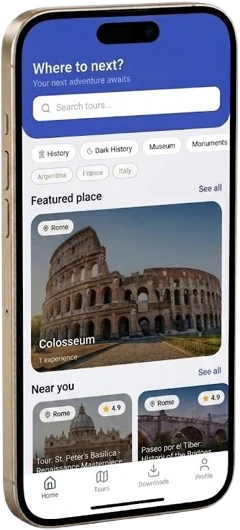
Before you start, download our free audio tour Turin: the City That Made Italy, Kept the Shroud and Built FIAT. It covers 12 stops, from the Roman Palatine Gate and the cathedral of the Shroud to the Savoy palace, the Egyptian Museum, the Mole and the Lingotto, and ends on the hill of Superga. It is self guided, goes at your own pace and works offline, so you can listen under the arcades without roaming data.