Pompeii Day Trip: Tickets, Getting There and What You Can't Miss
Your Pompeii ticket has your name printed on it. Since November 2024 the Archaeological Park has sold nominative tickets with a hard cap of 20,000 visitors a day, and from mid-March to mid-October entry is split into time slots. In practice this means two things: you can no longer turn up at noon in August and hope for the best, and the ID you carry has to match the name on the ticket. The other thing most day-trippers underestimate is size. The walled city covers about 66 hectares, roughly a third of it is still buried, and the part that is open takes a full day to walk properly. So the trick to a good Pompeii day trip is not seeing everything. It is choosing well.
Pompeii Tickets in 2026
Prices changed on January 12, 2026. The official options (check pompeiisites.org before you buy, since the park adjusts rules often):
- Pompeii Express, €20: the ancient city only, one entry. If you change your mind inside, you can add the suburban villas for €8 at the Porta Ercolano exit (card only).
- Pompeii+, €25: the city plus the Villa of the Mysteries, the Villa of Diomedes and Villa Regina in Boscoreale with its Antiquarium, with shuttle bus. This is the one most first-timers want, because the Villa of the Mysteries is the best painted room in Pompeii.
- Pompeii Plus, €30: valid three days, one entry each to Pompeii, Oplontis, Stabiae and Boscoreale. Yes, "Pompeii+" and "Pompeii Plus" are two different tickets. Read carefully before you pay.
- Reduced, €2: EU citizens aged 18 to 24. Under-18s generally enter free at Italian state sites, but they still need a ticket.
- Free first Sunday of the month: you still need a free ticket, and it gets very crowded.
The official seller is Vivaticket (linked from pompeiisites.org).
Time slots (March 16 to October 14): 15,000 entries between 9 a.m. and 1 p.m., and only 5,000 between 1 p.m. and 5:30 p.m. Afternoon slots sell out faster than people expect, especially for Pompeii+.
Hours: in summer (mid-March to mid-October) 9 a.m. to 7 p.m., last entry 5:30 p.m. In winter 9 a.m. to 5 p.m., last entry 3:30 p.m. Closed December 25 and January 1.
Getting There from Naples
The ruins sit next to Pompei Scavi–Villa dei Misteri station, a few minutes on foot from the Porta Marina entrance, the closest one to the Forum.
- Circumvesuviana (EAV): the cheap, chaotic local train. Take the Naples–Sorrento line from Porta Nolana or Piazza Garibaldi (under Napoli Centrale) and get off at Pompei Scavi. About 35 to 40 minutes, departures every half hour or so, fares around €3 to €4 one way. Trains are old, often packed and rarely air-conditioned. Keep your phone and wallet in front of you.
- Campania Express: the tourist version of the same line, with reserved seats and air conditioning, around €15 one way. It runs only a handful of times a day and mainly in the warm season, so check the EAV timetable the day before.
- Trenitalia regional: from Napoli Centrale to Pompei station (the town, not the ruins), then a walk of roughly 15 minutes to the Piazza Anfiteatro entrance.
Getting There from Rome
Pompeii from Rome is doable in a day, but it is a long one.
- High-speed train + local train: Frecciarossa or Italo from Roma Termini to Napoli Centrale takes about 1 hour 10 minutes. Then walk downstairs to Piazza Garibaldi and take the Circumvesuviana. Count on 2.5 to 3 hours door to door each way. Book the early train (before 8 a.m.) so you enter in the morning slot.
- Direct Sunday Frecciarossa: Trenitalia runs a Sunday train, FR 9693, leaving Roma Termini at 08:53 and reaching Pompei at 10:40, with the return FR 9568 at 18:40 (Roma 20:55). You can add the Pompei Link shuttle bus to the ruins when you buy it. Trenitalia changes these seasonal services, so confirm the date in the app.
A Route That Fits One Day
With four to five hours inside, this loop covers the essentials without crossing the site three times:
- Porta Marina and the Basilica: you enter through the old sea gate. The Basilica was the law court, not a church.
- The Forum: the photo you came for, with the Temple of Jupiter framed by Vesuvius. Stand here and look at the volcano: in 79 AD nobody in town knew it was a volcano.
- Forum Baths and the House of the Tragic Poet: the famous Cave Canem (beware of the dog) mosaic is at the door.
- House of the Faun: the largest house in Pompeii, one full city block. The Alexander mosaic is a copy; the original is in Naples.
- House of the Vettii: reopened in 2023 after twenty years of restoration, with some of the best frescoes on the site.
- The Lupanar: the small brothel with its explicit paintings and graffiti. Expect a queue.
- Stabian Baths and the Large Theatre: the oldest baths in town and a theatre for around 5,000 people.
- Via dell'Abbondanza: the main street, with shop counters, stepping stones and election slogans painted on the walls.
- The Amphitheatre: the oldest surviving Roman stone amphitheatre, built around 70 BC. In 59 AD a brawl with fans from nearby Nuceria ended in deaths, and Rome banned games here for ten years.
- Garden of the Fugitives: plaster casts of thirteen people who tried to escape. It is the quietest corner of the site and the hardest one to forget.
With a Pompeii+ ticket, the Villa of the Mysteries is a 10 to 15 minute walk past Porta Ercolano along the Street of the Tombs. Its red frieze is worth the detour.
What to skip on a short visit: Boscoreale and the outer villas unless you have a second day, and any plan to also climb Vesuvius the same afternoon.
Herculaneum: Alternative or Combination
Herculaneum is the smaller sister: about 4.5 hectares open, three or four hours to see well, and better preserved because it was buried deeper, under up to 20 metres of volcanic material. You see carbonized wooden beams, upper floors and, in the old boathouses by the shore, the skeletons of around 300 people who waited for a rescue that never came.
- Getting there: Circumvesuviana to Ercolano Scavi, about 20 minutes from Naples, then a 10 minute walk downhill.
- Tickets and hours: the full ticket has been around €13, and summer hours run 8:30 a.m. to 7:30 p.m. (last entry 6 p.m.). Check ercolano.cultura.gov.it before you go.
- Combining both: doable but tiring. Do Herculaneum first (it opens at 8:30), take the train to Pompei Scavi around midday and use an afternoon slot. In winter, Pompeii's last entry at 3:30 p.m. makes this very tight.
Heat, Water and Practical Tips
- Heat: there is almost no shade and the basalt and walls reflect the sun. In July and August it easily passes 30 °C. Enter at 9 a.m. or after 3 p.m.
- Water: bring a refillable bottle. There are drinking fountains inside the site, and the café near the Forum is the only real food stop.
- Shoes: the paving stones are uneven and polished. Wear proper sneakers, not sandals.
- Bags: large backpacks and suitcases have to go to the cloakroom at the entrance.
- ID: your name is on the ticket. Bring the passport or ID card you used to book.
- Best season: April, May, late September and October. Fewer people, softer light, and Vesuvius visible more often.
Explore Pompeii with Trevurs
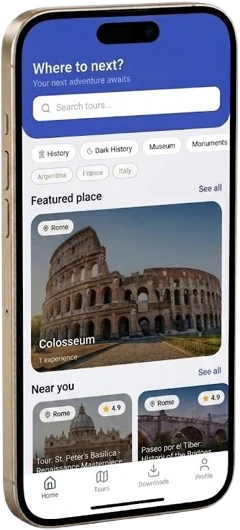
Pompeii without context is a lot of walls in the sun. With the free Trevurs audio tour "Pompeii: One Day Before the End", you walk from the Forum to the Garden of the Fugitives listening to how people lived there the day before the eruption. If you add Herculaneum, "Herculaneum: the Town Pompeii Overshadowed, Better Preserved and Less Visited" covers it, and back in the city "Naples: Vesuvius, Pizza and the City Underground" finishes the trip. All Trevurs tours are free, self-guided and work offline, which matters inside the ruins, where the signal comes and goes.