3 Days in Vienna: Palaces, Coffee Houses and the Ringstrasse
The Habsburgs ruled from Vienna for more than 600 years, and the city never quite stopped dressing like it. That is the key to a good 3 days here: you are not visiting a museum city, you are walking through the leftover stage set of an empire. This itinerary groups the sights by zone so you spend your time looking at palaces, not waiting for trams.
Before you go: tickets and transport
Vienna changed its fares in 2026. The 48 and 72-hour tickets were discontinued, so for three days the 7-day Wiener Linien ticket (roughly EUR 25 to 29, verify on the official site) usually beats three 24-hour tickets (about EUR 10 each). A single ticket costs about EUR 3.20 and is valid for 80 minutes with transfers. The Vienna City Card is worth it only if you plan many paid museums, so do the maths first.
Palace tickets also changed names. At Schönbrunn, the old Imperial Tour is now the State Apartments ticket and the old Grand Tour is the Palace Ticket. Expect roughly EUR 28 to 30 and EUR 38 to 42 for adults (prices vary by source and season, so check schoenbrunn.at). Book a timed slot online, especially from April to October.
Day 1: The Ringstrasse and the Hofburg
Start at the Hofburg, the Habsburg winter residence for over six centuries. It is a complex of 18 wings, so do not try to see everything. Pick the Imperial Apartments, Sisi Museum and Silver Collection (allow 2 hours, around EUR 18 to 20, verify before you go). The silver and the dining table set for a state banquet explain the court better than any textbook.
Walk out through the Heldenplatz, then follow the Ringstrasse, the 5.3 km boulevard built from 1857 on the old city fortifications. It lines up the Parliament, the Rathaus, the University, the Burgtheater and the Opera. You do not need to enter all of them. Walking it takes about 90 minutes at a relaxed pace, or take tram line 1 or 2 for a cheap loop with windows.
Finish at St. Stephen's Cathedral in the Innere Stadt. The roof with its zigzag tiles is the postcard, but the real tip is to climb the south tower (343 steps, a few euros) for the view over the old town.
Day 2: Schönbrunn and Naschmarkt
Go to Schönbrunn early, ideally at opening time. The palace has 1,441 rooms, and only a small share is open to visitors. Take the State Apartments route if you are short on time, or the Palace Ticket if you want the full imperial tour with audioguide. A young Mozart reportedly played here for Empress Maria Theresa at age six, which tells you how seriously this court took its entertainment.
Do not skip the gardens. The grounds are free to enter, and the walk up to the Gloriette takes about 20 minutes and rewards you with the best view of the palace. Budget 3 to 4 hours for the whole site.
In the afternoon, take the U4 to Kettenbrückengasse and walk through the Naschmarkt. It runs for around 500 metres with stalls selling olives, spices, kebabs and Austrian cheeses. Prices at the front stalls are tourist prices, so eat toward the middle. On Saturday the flea market at the far end is a good place to browse for old postcards and coins. Nearby, the Secession building shows Klimt's Beethoven Frieze, a short but memorable visit.
Day 3: Belvedere, coffee houses and the dark side
Visit the Upper Belvedere in the morning to see Klimt's The Kiss. Go at opening time, because by 11:00 the room is a crowd. Tickets are around EUR 20 to 25 depending on the combination (verify). If you are not an art person, the gardens alone make a fine walk toward the Lower Belvedere.
Then do what Viennese people have done since the 1800s: sit in a coffee house. UNESCO lists Viennese coffee house culture as intangible heritage. Order a Melange, a small glass of water arrives for free, and nobody will rush you. Café Central and Demel are famous and busy, so for a quieter choice look for a neighborhood Kaffeehaus a few streets from the Ring.
Spend the late afternoon in the Prater, where the Riesenrad (1897) still turns. A ride costs about EUR 15 to 17 (check current price). It is a slow, 12 minute loop, and the cabins have not changed much since Vienna was an imperial capital.
What to skip
- The horse-drawn Fiaker carriages around Stephansplatz. They are expensive for what you get, so always agree on the price before climbing in.
- Eating in front of the Opera or in the tourist restaurants of the Graben. Walk two streets away.
- Trying to do the Hofburg, Schönbrunn and Belvedere in a single day. You will remember none of them.
Where to stay
The Innere Stadt puts you within walking distance of the Ring, but costs more. Neubau and Josefstadt are calmer, cheaper and well connected by U2, U3 and trams. Avoid hotels far from a U-Bahn line: you will lose time every day.
Explore Vienna with Trevurs
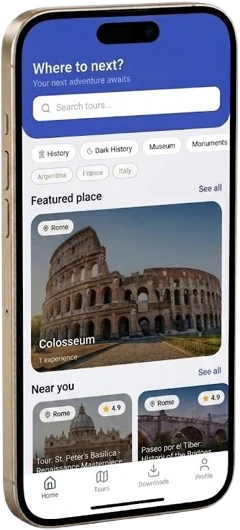
Trevurs has free, self-guided audio tours that work offline, which is handy when you want to understand what you are looking at. The Habsburgs: 600 Years of Power, Madness, and Fall walks you through the dynasty that built the city, and Dark Vienna: 1914 and the End of an Empire of 50 Million shows the other side of the same streets. Download them before you leave and listen as you walk.